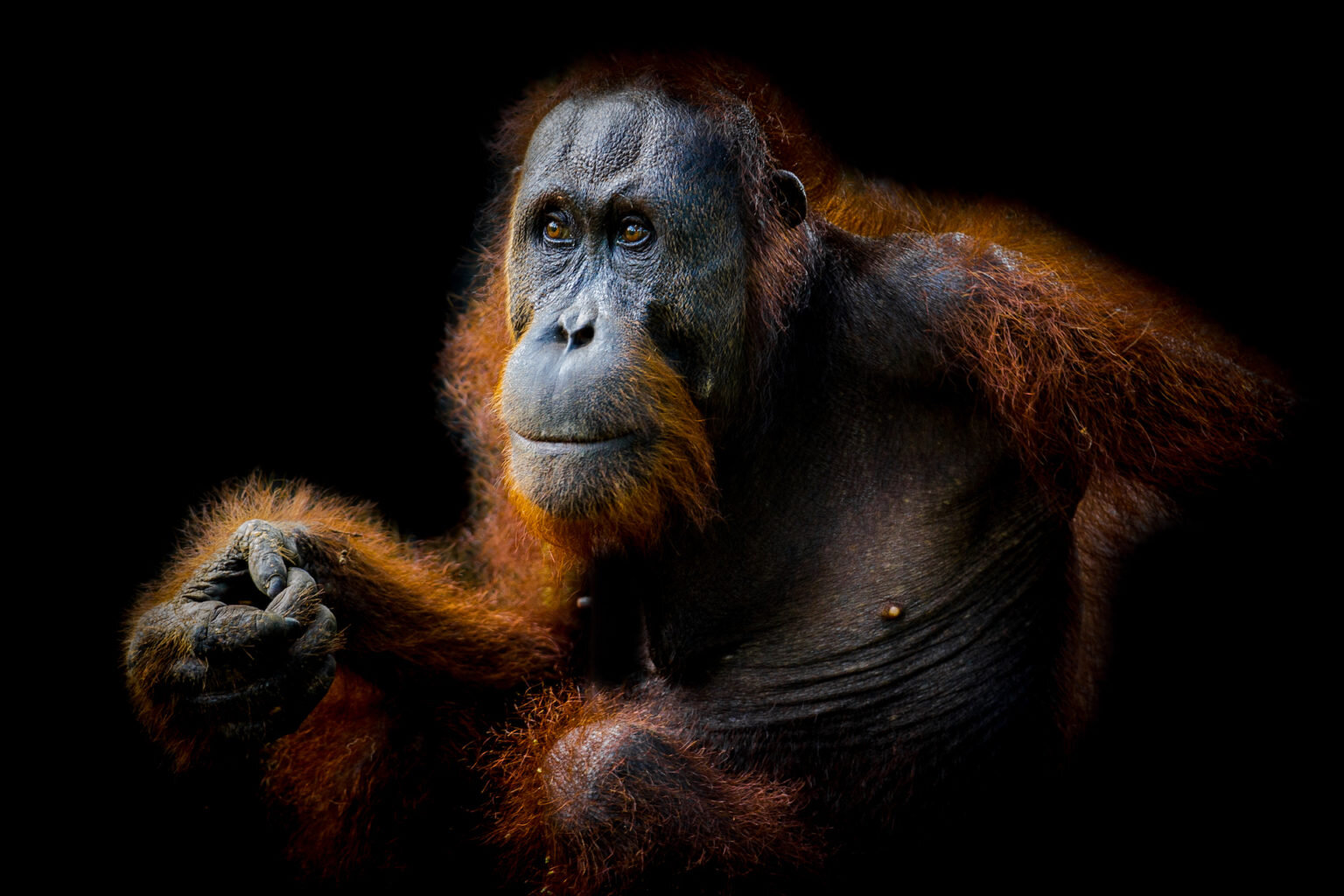
The eyes and facial features of Orangutans are a photographers dream. The faces of older Orangutans project wisdom and a sad understanding of the perils facing their kind in the form of rampant unchecked deforestation of Borneo and Sumatra. The faces of younger ones, ignorant of their plight, display a cockiness and mischievousness that comes with youth. However it’s a cockiness that quickly disappears as the realities of life in an ever diminishing homeland becomes apparent in the form of starvation or a life confined behind bars in a zoo.
Orangutans are absolutely magnificent animals that once freely roamed the dense jungles of Borneo and Sumatra. Sadly due to uncontrolled destruction of the forests without any consideration to its consequences by logging and palm oil plantation companys Orangutans in Sumatra are now critically endangered and those in Borneo endangered. Increasingly confined to small pockets of isolated dense forests their plight as a species is very serious and the likelihood of their becoming completely extinct in the wild, except for limited numbers in a few protected reserves within the next ten to fifteen years is extremely high.
The desperate plight of Orangutans is wonderfully presented in a heart wrenching must watch documentary about an Orangutan called Green which can be viewed at http://www.greenthefilm.com/ After seeing these magnificent jungle people in the wild and watching the movie one can’t help but wonder what is it that makes mankind so ignorant and uncaring for a species that is almost as human as we are.
After years of living in Malaysia and never finding the time to travel to Borneo we finally we got round to visiting the Orangutan Rehabilitation center in Sepilok, Sabah. Sepilok may only be a short thirty minutes drive out of Sandakan, a small seaport town in the top north east of Borneo, but it’s a twenty years old ambition finally put to bed. And what a trip it was. Fantastic is the only words to describe it.
Centers like the one in Sepilok which rescue captured, injured or displaced Orangutans and rehabilitate them back into the wild are their only hope. Young Orangutans spend time in a nursery learning skills essential to life in the jungle such as climbing and using the trees for mobility, finding food and building sleeping nests that they would usually quire from their mothers. Once ready, they are moved to an outdoor nursery where their freedom is increased and their dependence on food and emotional support of their handlers is gradually reduced. Eventually most animals achieve independence and become integrated into the wild population within the broader Sepilok protected forest reserve.
Visitors to Sepilok get to view the Orangutans in the process of becoming habituated back into the wild within the outdoor nursery area. Twice a day food is placed on a feeding platform for any of the Orangutans not quite able to survive alone in the forest without it. This provides an opportunity to observe a variety of big and small animals as they leisurely swing in to see what’s on offer for the day. Interestingly on both the visits we made to the center it seemed to us that the Orangutans were not really hungry as some didn’t eat at all, a sure sign that they were surviving fine alone in the jungle. We got the impression that for some of those visiting the feeding platform it was an opportunity to meet up with others of their kind, as much as it was to sample a free meal.
When we entered the park we were told that the feeding platform is the most likely place to see these animals, and that once they leave the leave the platform area they are very difficult to spot. Fortunately for us our luck was in when on our way back to the entrance after watching some feeding we were very surprised and happy to come across a small group of about five younger Orangutans on and above the walkway. This was exactly what we wanted to see, these great apes free and wild. What an experience!
The wannabe camera thief moments before he swung over and grabbed the camera strap
However, as a reminder that the Orangutans in the wild, and like all wild animals need to be treated with caution, one older male in the group took exception to the people around us as well as my photographing him and his mates. His intent was clear; he wanted everyone near them away from them. At first he accosted a woman who was wearing orange-brown pants similar to the hair color of the Orangutan. Then although I was standing well back from her he turned on me. All it took was a quick few steps and he was right next to me with a firm grasp on a hanging camera strap. Fearing that if I let go it would be sent flying from twenty meters up there was no way I was going to let him get away with it. Finally after a few moments of intense tugging and pulling I managed to get the camera free, quite a feat considering the strong grip that these animals have. But this was something that seemed to annoy him even more because he then bent down and with an arm round my leg started chewing the side of my shoe. Worried he would bite my leg I grabbed a handful of orange fur and tried to pull him off, but it was hopeless. In the end the only way to resolve the situation was to give him a sharp sideways kick in the chops. End of the drama!
The wonderful thing about Orangutans is that they have such great individual character. Something that is very interesting to photograph. They are so photogenic it’s almost impossible to take a lousy photo of them. The more I clicked away, the more attracted I was by their facial features and I switched from general behavioral shots to trying to get portraits.
Sepilok, near Sandakan in the north east corner of Borneo is easily accessed by a number of flights daily. It’s worth the effort to go there and I seriously encourage any photographer heading to Malaysia or Singapore to do a side trip up there. It’s really worth it. We stayed in the Four Points Sheraton in Sandakan and hired a car and drove ourselves around. It was easy and cheap. For those wanting a more jungle experience there are numerous jungle resorts and lodges that can also be booked for very reasonable rates.
Now my appetite has been whetted…the next trip will be to the Kinanbatangan River and Danum Valley. Can’t wait!!